Lvxin Auto Parts (Anji) Co., Ltd
How to Choose the Right Ratchet Tie Down Strap for a Flatbed Trailer
Choosing the right ratchet tie down strap for a flatbed trailer is essential for keeping cargo secure during transportation. The correct strap should match the cargo weight, load configuration, working conditions, and tie-down points. For trucking companies, fleets, and cargo haulers, selecting the right combination can also help improve loading efficiency and reduce the risk of cargo movement.
1. Check the Working Load Limit (WLL)
The first factor to consider is the Working Load Limit (WLL).
WLL indicates the maximum load a tie-down assembly is designed to secure under specified conditions. Do not select a strap simply based on its breaking strength. The working load limit is the more useful value when determining whether a strap is appropriate for a particular application.
Common flatbed trailer straps include:
- 2-inch straps – suitable for many general cargo applications
- 3-inch straps – commonly used for heavier flatbed cargo
- 4-inch straps – available for demanding heavy-duty applications
For commercial transportation, always calculate the required securement capacity based on the cargo and applicable regulations rather than choosing a strap based only on appearance or webbing width.
2. Choose the Correct Strap Length
The strap needs to be long enough to pass around the cargo and connect securely to the trailer’s anchor points.
Common lengths include:
- 20 ft
- 27 ft
- 30 ft
- 40 ft
- Custom lengths
For flatbed trailers, 27-ft and 30-ft straps are commonly used because they provide sufficient length for many standard cargo configurations.
However, excessively long straps can create unnecessary loose webbing. Choose a length that provides adequate coverage without excessive slack.
3. Select the Right End Fitting
The end fitting should match the anchor points on your flatbed trailer.
Popular options include:
Flat Hook
A flat hook is commonly used with trailer stake pockets and compatible anchor points.
Wire Hook
Wire hooks are lightweight and versatile for various trailer configurations.
Chain End
Chain-end straps are useful for applications requiring a robust connection to specific anchor points.
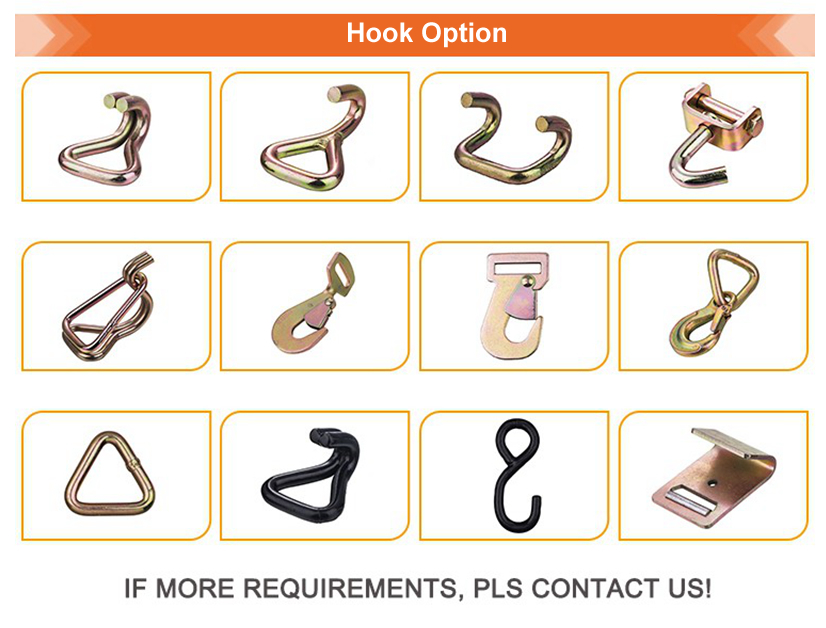
J Hook
J hooks can be suitable for particular trailer and cargo securement configurations.
Before ordering in bulk, confirm the trailer’s anchor-point design to make sure the hook can be installed and removed efficiently.
4. Consider the Ratchet Handle Design
The ratchet mechanism affects both durability and operator efficiency.
A good ratchet should provide:
- Smooth operation
- Strong gear teeth
- Reliable locking
- Comfortable handle operation
- Corrosion-resistant components
For fleet operations, a wide-handle or ergonomic ratchet can make repeated loading and unloading easier for drivers.
5. Pay Attention to Webbing Material
Most heavy-duty tie-down straps use polyester webbing because it provides good strength, durability, and resistance to stretching.
When purchasing straps, check:
- Webbing width
- Webbing thickness
- Material
- Stitching quality
- Abrasion resistance
- UV and weather resistance
For flatbed transportation, reinforced stitching and durable webbing are particularly important because straps are frequently exposed to weather, sharp cargo edges, and repeated handling.
6. Protect the Strap From Sharp Edges
Even a high-strength strap can be damaged by sharp cargo edges.
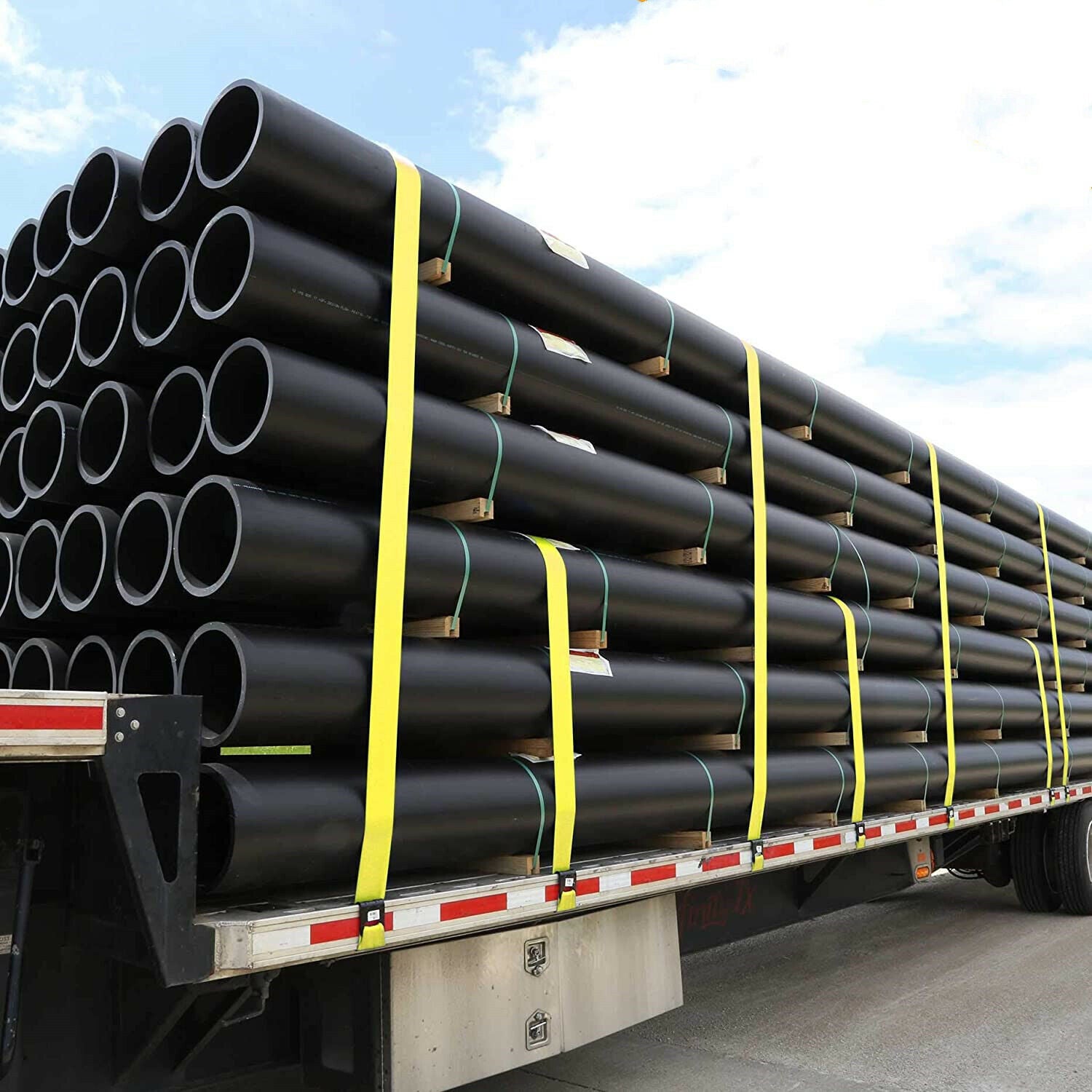
When transporting steel products, machinery, lumber, pipes, or other products with corners, consider using:
- Corner protectors
- Wear sleeves
- Protective pads
- Heavy-duty webbing sleeves
These accessories can help reduce abrasion and distribute pressure across the webbing.
7. Inspect Straps Before Every Use
Ratchet straps should be inspected before use.
Look for:
- Cuts or tears
- Excessive abrasion
- Burn or heat damage
- Broken stitching
- Damaged hooks
- Bent or cracked ratchet components
- Severe chemical or weather damage
If a strap shows serious damage, it should be removed from service rather than reused.
8. Consider Your Cargo Type
Different cargo requires different securement solutions.
| Cargo Type | Recommended Considerations |
|---|---|
| Lumber | Heavy-duty webbing + edge protection |
| Steel coils | High-capacity securement system |
| Machinery | High WLL + appropriate anchor points |
| Pipes | Strong straps + corner protection |
| Construction materials | Durable webbing + suitable hooks |
| General freight | Standard 2″ or 3″ ratchet straps |
The cargo’s weight, dimensions, shape, center of gravity, and surface characteristics should all be considered when selecting a securement system.
9. Check Applicable Regulations
For commercial trucking, cargo securement requirements depend on the country and jurisdiction. In the United States, flatbed operators should ensure their securement system complies with applicable FMCSA cargo securement requirements.
The strap’s WLL, the number of tie-downs, tie-down arrangement, and cargo characteristics all need to be considered together.
10. Choose a Reliable Supplier
For trucking companies, distributors, and fleet operators purchasing ratchet tie down straps in bulk, the supplier’s manufacturing capability is also important.
When evaluating a factory, ask about:
- Webbing specifications
- Ratchet material
- Hook options
- WLL and breaking strength
- Stitching standards
- Testing procedures
- Custom colors and labels
- Packaging
- Production capacity
- Quality inspection
For OEM and private-label orders, a manufacturer should also be able to provide customized webbing color, logo, label, length, hook type, and packaging.
Final Thoughts
Choosing the right ratchet tie down strap for a flatbed trailer is about more than selecting a strong strap. The correct solution should combine the appropriate WLL, webbing width, length, end fitting, ratchet mechanism, cargo protection, and inspection practices.
For fleet operators and cargo transportation companies, properly specified tie-down straps can provide a practical and repeatable cargo-securement solution across different loads.