Lvxin Auto Parts (Anji) Co., Ltd

Winter Survival: The Ultimate Guide to Heavy-Duty Truck Snow Chains
When the first blizzard hits the Rocky Mountains or the Cascades, the difference between a successful delivery and a multi-ton disaster comes down to one thing: Traction. For fleet managers and owner-operators in North America, “Snow Chain Season” is more than a recommendation—it’s a legal and safety mandate. In this guide, we break down the engineering, the regulations, and the maintenance of high-performance tire chains.
1. Why “Off-the-Shelf” Isn’t Enough: The Lvxin Engineering Standard
Not all chains are created equal. In heavy-duty trucking, the forces exerted on a tire chain during a hill climb are immense. Standard consumer chains will snap under the torque of a Class 8 tractor.
- Material Matters: High-quality chains must be forged from Manganese Alloy Steel. This material provides the perfect balance of hardness (to bite into ice) and ductility (to resist snapping in sub-zero temperatures).
- The “V-Bar” Advantage: For extreme icy conditions, V-Bar (Ice Studded) chains are the gold standard. The reinforced “V” spikes act like claws, digging into frozen surfaces where smooth link chains would simply spin.
2. Navigating the “Chain Laws”: Stay Compliant, Stay Moving
In states like Colorado, Washington, and California, “Chain Laws” are strictly enforced.
- The “Carry” Requirement: Many states require trucks to carry chains as early as September, even if the roads are clear.
- The Fine Print: Failure to chain up when the lights are flashing can result in fines exceeding $500, but the real cost is the risk of “spinning out” and blocking a major interstate, which can lead to thousands of dollars in towing fees and insurance spikes.
3. Choosing the Right Fit: Singles, Duals, and Triples
Understanding your fleet’s specific needs is key to inventory management:
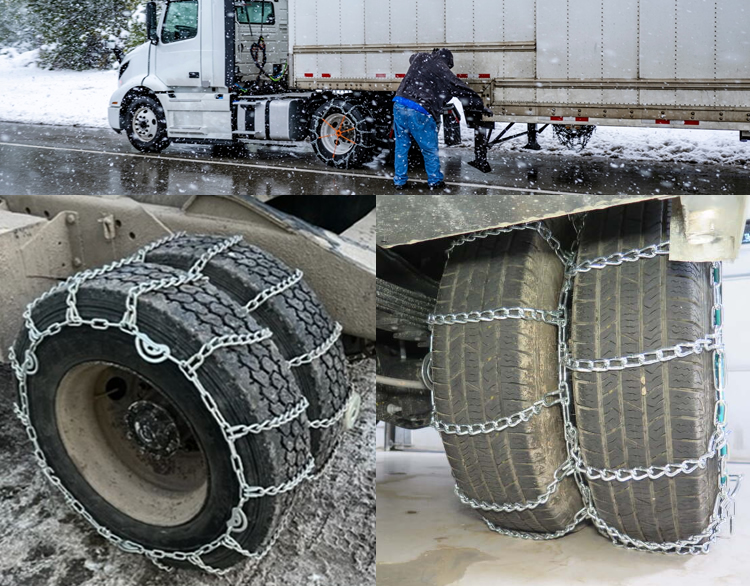
- Single Chains: The standard for most steer or drive axles. Easy to stow and quick to install.
- Dual Triple Chains: These cover both tires on a dual-drive axle, providing a massive footprint of traction. Essential for heavy haulers tackling steep mountain passes.
- Automatic Chains: For urban delivery fleets, automatic “throw” chains provide instant traction at the flip of a switch, though they aren’t a replacement for manual chains in deep mountain snow.
4. Pro-Tips for Longevity: The 10-Year Expert Checklist
Having served the North American trucking industry for over a decade, Lvxin recommends these three “Life-Extenders” for your chains:
- The Tension Check: A loose chain is a broken chain. Always use Rubber Adjusters (Spider Tensioners) to keep the chain centered. After driving the first 1/4 mile, stop and re-tighten.
- Avoid Dry Pavement: Running chains on bare asphalt is the fastest way to ruin the heat-treatment of the steel. Remove them as soon as you hit clear road.
- The Post-Season Rinse: Road salt is the “silent killer.” Always wash your chains with fresh water and spray them with a light coat of anti-rust lubricant (like WD-40) before summer storage.
🛡️ The Lvxin Difference: Built for the North
“We don’t just sell steel; we sell security.”
At Lvxin, our heavy-duty snow chains are 100% Proof-Tested. We understand that when a driver is chaining up on the side of a freezing highway, they need a product that fits perfectly and locks securely. Our Cam-Lock systems are designed for gloved hands, ensuring that you spend less time in the cold and more time behind the wheel.